The 2026 California ADU Blueprint: Navigating New Laws, Fast-Track Permits, and Maximizing Property Value
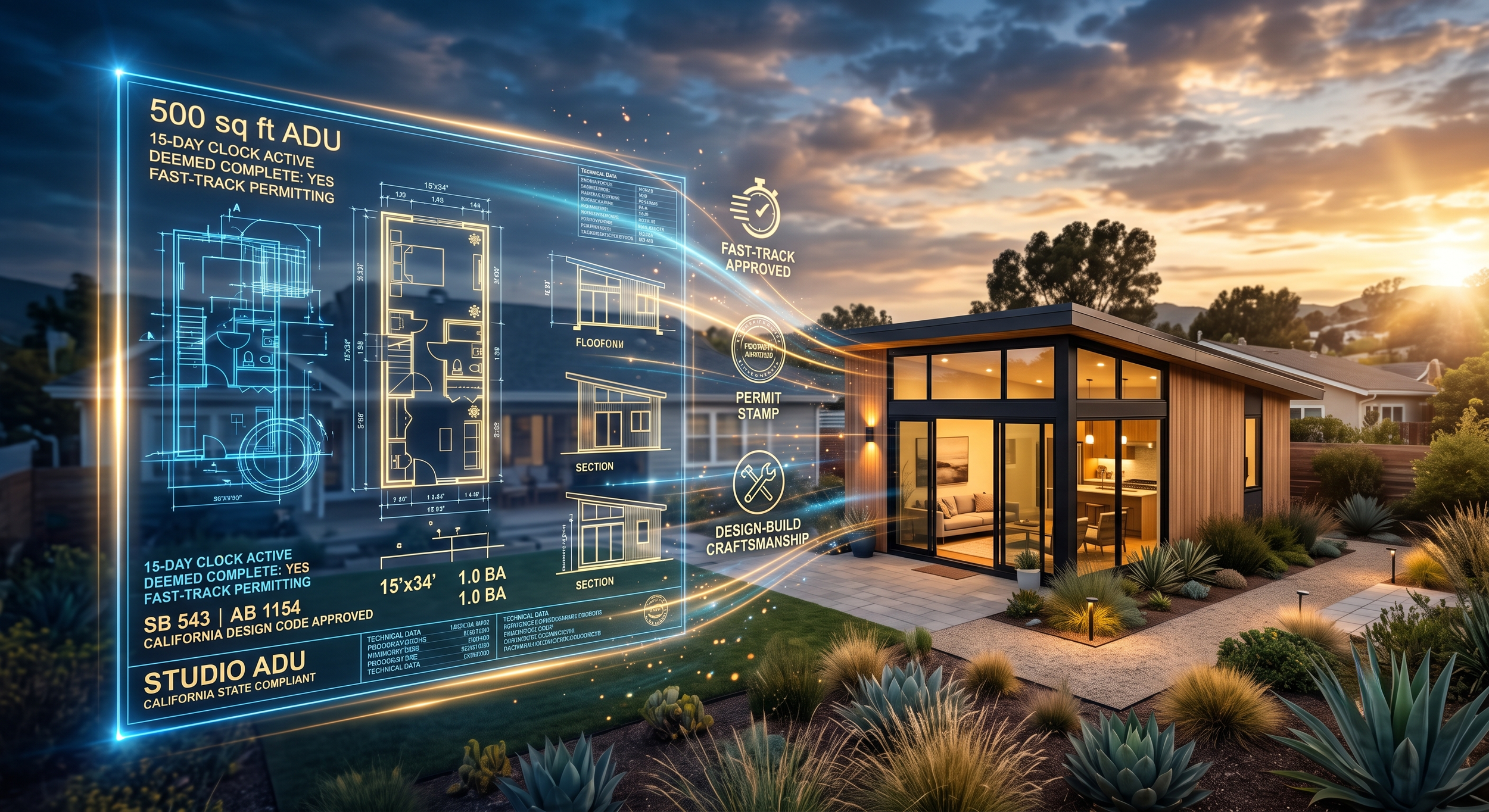
TL;DR for Property Investors:California’s recent ADU legislation includes (SB 543, AB 1154, and AB 462) designed to eliminate red tape for Accessory Dwelling Units (ADUs). Key benefits include a 15-business-day completeness review, generally followed by a 60-day approval-or-denial period after a complete application, subject to statutory exceptions, size limits applied only to "interior livable space," massive fee exemptions, and the elimination of owner-occupancy requirements for Junior ADUs (JADUs).
Thinking about adding an Accessory Dwelling Unit (ADU) or a Junior ADU (JADU) to your California property? Welcome to the golden era of backyard building.
For years, homeowners and investors have navigated a labyrinth of city delays, strict zoning rules, and unpredictable fees. Recent legislation changes parts of the process: SB 543 and AB 1154 took effect January 1, 2026, while AB 462 took effect October 10, 2025. Whether you are looking to house family members, build a home office, or generate a high-yield rental income, the state of California just handed you the ultimate architectural playbook.
Here is an in-depth, no-nonsense guide to how the 2026 updates work to your distinct advantage:
1. Eradicating Bureaucratic Bottlenecks: The 15-Day Clock (SB 543)
Historically, the most agonizing part of construction has been the "permit limbo." SB 543 introduces unprecedented accountability for local municipalities:
Completeness review: The local agency has 15 business days to determine whether the application is complete. Missing the applicable deadline may deem the application complete; it does not by itself approve the permit.
No Endless Moving Targets: Once the initial review is done, planning departments are legally prohibited from coming back with new, random requests. They can only enforce items flagged in the first letter.
Approval or denial: For an existing primary dwelling, the decision is generally due within 60 days after a complete application, subject to statutory conditions and exceptions. A new primary dwelling or an applicant-requested delay can affect timing; completeness is not permit approval.
2. Spatial Optimization: The "Interior Livable Space" Paradigm (SB 543)
Previously, strict ADU size limits included the thickness of your exterior walls, staircases, and mechanical rooms. This inherently penalized high-quality, durable construction.
The Fix: Under the new law, size limits (such as the 500 sq. ft. cap for JADUs or the 800 sq. ft. state-exempt ADU) apply exclusively to interior livable space.
The Impact: You gain actual, usable square footage without violating the footprint limits. Your ADU will literally feel—and function—larger.
3. Economic Viability: Massive Utility and Fee Reductions (SB 543)
Capital efficiency is the key to any successful real estate project. The 2026 updates heavily restrict local agencies from treating your ADU as an ATM:
Utility connections and charges depend on the approval route: Under Government Code §66311.5(d), a qualifying ADU or JADU described in §66323(a)(1) generally cannot be required to install a new or separate utility connection or pay a related connection fee or capacity charge. Exceptions include a unit built with a new single-family dwelling and a unit separately conveyed under §66342. For other ADUs, §66311.5(e) allows a new or separate connection and proportionate charges based on the unit’s burden on the system. Confirm the applicable route and utility requirements for the property; there is no blanket fee waiver or guaranteed savings.
Impact Fee Exemptions: Building under 500 sq. ft.? You are entirely exempt from school impact fees. Building under 750 sq. ft.? Say goodbye to standard impact fees altogether.
4. The Ultimate ROI: Unlocking Junior ADUs (AB 1154)
Want to build a Junior ADU (JADU) inside the existing footprint of your home? AB 1154 just made it the most attractive investment in the state.
No Owner-Occupancy Mandates: Previously, you had to live on the property to legally rent out a JADU. Now, provided the JADU has its own private bathroom, you do not need to live on-site. You can legally rent out both the main house and the JADU simultaneously to long-term tenants.
5. Fast-Tracking Coastal and High-Risk Zones (AB 462)
For property in coastal areas or affected by a disaster, AB 462 provides specific procedures and conditional relief; location alone does not establish eligibility.
Coastal permits and disaster-recovery provisions: AB 462 took effect October 10, 2025. It establishes a 60-day approval-or-denial rule for a complete ADU coastal development permit application, subject to the law’s conditions and exceptions. The Coastal Act still applies; this is not a blanket coastal permit exemption. The law also permits occupancy of a qualifying detached ADU before completion of a disaster-damaged or destroyed primary dwelling, when the statutory conditions are met. Eligibility and the applicable permit path require property-specific review; no overall approval or construction timeline is guaranteed.
The Big Picture: Mastering the "Design-Build" Approach
Under the 2026 framework, you can legally combine a detached ADU, a converted ADU, and a JADU on a single-family lot. However, navigating California’s Title 24 energy codes, local Chapter 7A fire-hardening regulations, and these new zoning laws requires more than just a contractor—it requires visionary architectural design combined with precise engineering.
At Fine Craftsmanship Inc. (Ventura, CA), we specialize in turning complex code into beautifully materialized living spaces. Let’s unlock the hidden potential of your property.
👉 Ready to maximize your lot's value?Contact us today to map out your 2026 ADU timeline.
Reviewed October 3, 2026 — official sources for the timing, utility and coastal corrections: SB 543; Government Code §66311.5(d)–(e); AB 462; HCD ADU Handbook, March 2026. This article provides general information, not a project-specific permit determination.